Hinh website 2026 01 29T214823.807
“Scroll down to the end of the article to listen to music.”
Introduction

Some songs are written to entertain, and some are written because the writer had no choice but to get the words out. Toby Keith’s “Courtesy of the Red, White and Blue (The Angry American)” falls firmly into that second category. Released in 2002, the song was born out of Toby’s grief after losing his father, a proud Army veteran, and the anger that swept the nation following the September 11th attacks.

This wasn’t a carefully polished Nashville ballad — it was raw, direct, and fueled by emotion. Toby has said he wrote it in about 20 minutes, almost like it poured out of him. And you can feel that urgency in every line. The song is defiant, patriotic, even confrontational, but at its core, it’s personal. It’s Toby saying: This is how I feel. This is my truth.

Musically, it leans on straight-ahead country-rock energy — pounding drums, roaring guitars, and Toby’s booming baritone leading the charge. It’s less about subtlety and more about strength, capturing the collective spirit of a country still reeling from loss but determined not to bow.

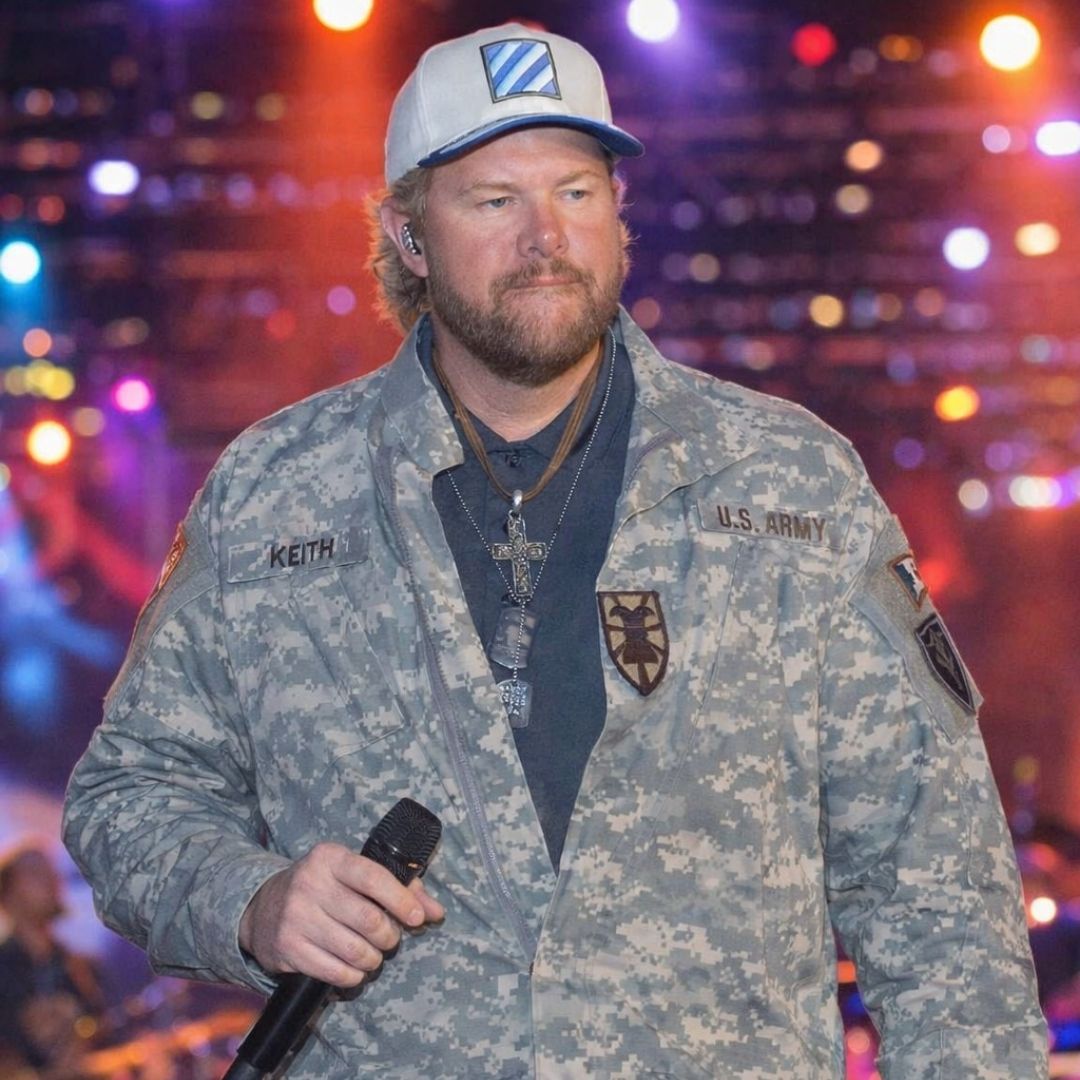
When Toby performed it for U.S. troops overseas, it became more than just a song — it was an anthem of solidarity. Soldiers cheered, sang along, and carried it with them like a battle cry. For others, it was controversial, even polarizing, because it didn’t shy away from blunt language and imagery. But that was the point. Toby never intended it to be polite — he intended it to be real.

Two decades later, “Courtesy of the Red, White and Blue” remains one of Toby Keith’s most defining songs. It may not be tender like “You Shouldn’t Kiss Me Like This” or reflective like “Don’t Let the Old Man In,” but it captures another side of him: the straight-shooting son of a soldier, unafraid to say what he felt in the heat of the moment.

At the heart of the song is a simple message: America’s strength lies in its people, its pride, and its resilience. Love it or hate it, this song made sure no one could ignore Toby Keith — and it gave voice to a nation that desperately needed something to hold onto.

Video

Lyrics

American girls and American guys
We’ll always stand up and salute
We’ll always recognize
When we see Old Glory flying
There’s a lot of men dead
So we can sleep in peace at night when we lay down our head
My daddy served in the army
Where he lost his right eye but he flew a flag out in our yard
‘Til the day that he died
He wanted my mother, my brother, my sister and me
To grow up and live happy
In the land of the free
Now this nation that I love has fallen under attack
A mighty sucker punch came flyin’ in from somewhere in the back
Soon as we could see clearly
Through our big black eye
Man, we lit up your world
Like the fourth of July
Hey Uncle Sam, put your name at the top of his list
And the Statue of Liberty started shakin’ her fist
And the eagle will fly man, it’s gonna be hell
When you hear mother freedom start ringin’ her bell
And it feels like the whole wide world is raining down on you
Oh, brought to you courtesy of the red white and blue
Oh, and justice will be served and the battle will rage
This big dog will fight when you rattle his cage
And you’ll be sorry that you messed with
The U.S. of A.
‘Cause we’ll put a boot in your ass
It’s the American way
Hey Uncle Sam, put your name at the top of his list
And the Statue of Liberty started shakin’ her fist
And the eagle will fly it’s gonna be hell
When you hear mother freedom start ringin’ her bell
And it’ll feel like the whole wide world is raining down on you
Oh, brought to you courtesy of the red white and blue
Oh-oh, of the red, white and blue
Oh-oh, of my red, white and blue

Related Post

BEFORE TOBY KEITH WROTE THE ANGRIEST SONG OF HIS LIFE, THERE WAS HIS FATHER’S MISSING EYE — AND A FLAG THAT NEVER CAME DOWN FROM THE YARD. H.K. Covel was not famous. He was not the man onstage. He was the kind of Oklahoma father who carried his patriotism quietly, in the way he stood, the way he worked, the way the flag outside his home was never treated like decoration. He had paid for that flag with part of his body. In the Korean War, Toby Keith’s father lost an eye while serving his country. He came home changed, but not emptied. He raised his family with that same stubborn belief that America was not perfect, but it was worth standing for. Then, in March 2001, H.K. Covel was killed in a car accident. Toby was already a star by then, but grief made him a son again. He kept thinking about his father. About the missing eye. About the flag in the yard. About all the things a hard man teaches without ever sitting down to explain them. Six months later, the towers fell. America heard the explosion. Toby heard something older. He heard his father. That is where “Courtesy of the Red, White and Blue” came from — not just from rage, not just from television footage, not just from a country stunned by smoke and sirens. It came from a son who had already buried the man who taught him what that flag meant. People argued about the song. Some called it too angry. Some called it exactly what the moment needed. And maybe that is why Toby never sang it like a slogan. He sang it like a son who had watched the symbol become personal before the whole world did.

You Missed

BEFORE TOBY KEITH WROTE THE ANGRIEST SONG OF HIS LIFE, THERE WAS HIS FATHER’S MISSING EYE — AND A FLAG THAT NEVER CAME DOWN FROM THE YARD. H.K. Covel was not famous. He was not the man onstage. He was the kind of Oklahoma father who carried his patriotism quietly, in the way he stood, the way he worked, the way the flag outside his home was never treated like decoration. He had paid for that flag with part of his body. In the Korean War, Toby Keith’s father lost an eye while serving his country. He came home changed, but not emptied. He raised his family with that same stubborn belief that America was not perfect, but it was worth standing for. Then, in March 2001, H.K. Covel was killed in a car accident. Toby was already a star by then, but grief made him a son again. He kept thinking about his father. About the missing eye. About the flag in the yard. About all the things a hard man teaches without ever sitting down to explain them. Six months later, the towers fell. America heard the explosion. Toby heard something older. He heard his father. That is where “Courtesy of the Red, White and Blue” came from — not just from rage, not just from television footage, not just from a country stunned by smoke and sirens. It came from a son who had already buried the man who taught him what that flag meant. People argued about the song. Some called it too angry. Some called it exactly what the moment needed. And maybe that is why Toby never sang it like a slogan. He sang it like a son who had watched the symbol become personal before the whole world did.

AFTER 54 YEARS TOGETHER, GEORGE STRAIT LOOKED TOWARD NORMA — AND THE ROOM UNDERSTOOD THE SONG WAS BIGGER THAN THE STAGE. George Strait stepped into the spotlight, the warm lights falling across the shoulders of a man who had spent more than half a century singing to the world. But this time, the story was not in the cameras. It was in the front row. Norma, the girl he married when they were still young in Texas, sat quietly with the kind of expression only a lifetime can create. She had known George before the hat, before the arenas, before people called him the King of Country. She had also stood with him through the part fans rarely talk about — the loss of their daughter Jenifer in 1986, a grief George has always kept guarded. The audience waited for the familiar smile. The easy nod. The song they had come to hear. Instead, there was a pause. Not staged. Not dramatic. Just long enough for the room to feel the weight of what had followed him into every love song: the marriage, the miles, the private grief, the woman who stayed through all of it. George did not need to say much. A few soft words toward Norma, a lowered head, a voice not quite as steady as usual — that was enough for the room to understand. For decades, fans had sung his love songs like they belonged to everyone. That night, they felt where many of them had been pointing all along. To Norma. To the life behind the lyrics. To the woman who heard the quiet parts long before the crowd ever did.